
Letters From the Labyrinth 456
Jack Ketchum Lives

Good morning! I’m Brian Keene and this is Letters From the Labyrinth, a long-running weekly newsletter for friends, fans, and family. I’m writing this on Saturday morning. You’re reading it on Sunday morning. And if, like me, you’re in the path of Death Blizzard 2026*, by now we should be in the thick of it. Hope you are warm and safe.
*As I said on Algorithm Zero earlier this week, I know that The Weather Channel is calling it Winter Storm Fern, but Winter Storm Fern is a direct contradiction of the breathless apocalyptic reporting coming out of The Weather Channel itself. I submit that Death Blizzard 2026 is more fitting name.
We had intended to be in New Jersey this weekend to celebrate Mary’s week-long birthday with her side of the family, but the storm prevented that. To make up for it, both of my sons and I took her out for dinner and a movie on Friday night. The dinner was Vietnamese (one of her favorites, and one I’m quickly finding that I really enjoy) and the movie was Return to Silent Hill (her all-time favorite media franchise, and one that has clearly impacted her professional work as much as Don Coscarelli’s Phantasm has impacted mine).
But here’s the interesting thing — none of us would have even known there was a new Silent Hill movie out in theaters if author Wesley Southard hadn’t told me earlier in the week. I don’t know what the marketing budget was for this film, but it must have been nonexistent, because I’ve seen exactly zero advertisements. Nothing on TV. Nothing on social media or YouTube. Nothing in print. Now, you could say, “Well Brian, you and Mary aren’t the target age demographic for the movie” but I’m not sure that’s true. Mary has been a fan of the franchise since the original game back in 1999. But ev en if we allow for “They targeted a younger audience” — my sons are 34 and 17 (almost 18), respectively, and neither of them had seen any advertisements for the movie. And they consume media very differently than we do.
The marketing didn’t exist. Or, if it did exist, it failed. There were exactly two other people in the theater with us for a Friday evening showing. And you can’t blame the storm because that was still 24 hours away, minimum.
We saw a poster for another horror movie called Primate, which none of the four of us had heard of either. It was showing in the theater next to ours. I poked my head inside and there were exactly zero people in the audience, even though the movie was in mid-showing.
So… that’s two horror movies debuting in theaters this weekend with seemingly no effort spent on marketing.
Then add the absolute disaster that has been the marketing campaign for 28 Years Later: The Bone Temple. Reddit and social media are full of literally thousands of people — including many self-identifying fans of the franchise — who claim they were unaware this was a new, fourth film in the franchise, and simply assumed it was a rerelease of the movie that came out last year. That is an abysmal performance for any sort of marketing department or advertising firm. Compounding matters is the fact that moviegoers are still expressing that lack of awareness as the film is now in its second week at the box office.
What we are seeing here is what we saw during the last two horror crashes — marketing departments assume that horror fans will go see anything, and so they don’t put anything into promoting it to a wider audience. But horror fans have a glut of new content available at home — streaming movies and shows, books, video games, etc. If they don’t know something is available, or worse, if they think it’s a movie they already saw, they’re not going to show up and spend money. And then, you get a sudden spike of horror films not doing well at the box office and the suits in charge decide “Yeah, looks like Horror is dead again. Let’s make romantic comedies for a few years until interest spikes once more”.
Anyway, as for the film itself… Mary very much enjoyed it, and I enjoyed that she enjoyed it. My oldest son liked it, and my youngest approached it as he does all media right now — picking it apart with the eye of a creator and figuring out what worked and what didn’t.
Your enjoyment of it may or may not depend on your overall love of the franchise itself, or the video game it is an adaptation of. Speaking as someone who has no attachment to the franchise, and who has never played the video games, I can say that:
The producer in me was impressed with their sound mix.
The writer in me would not at all be surprised if we learned that AI was somehow used to “punch up” this script, because it is a dreadful and at times nonsensical mishmash of every cliche ever devised in the history of everything — and plot holes big enough to drive a truck through.
The moviegoer in me laughed at a protagonist who flees a succession of acid-spraying straight jacket monsters, weird insects, a weightlifter with a pyramid head, and murderous nurse puppets and tries to hide from all of them in the dark but never — not once — turns his f*$%ing flashlight off.
Anyway… Return To Silent Hill, Primate, and 28 Years Later: The Bone Temple are all in theatres now. The studio marketing departments can send me a check next week for promoting the three films more than they have.
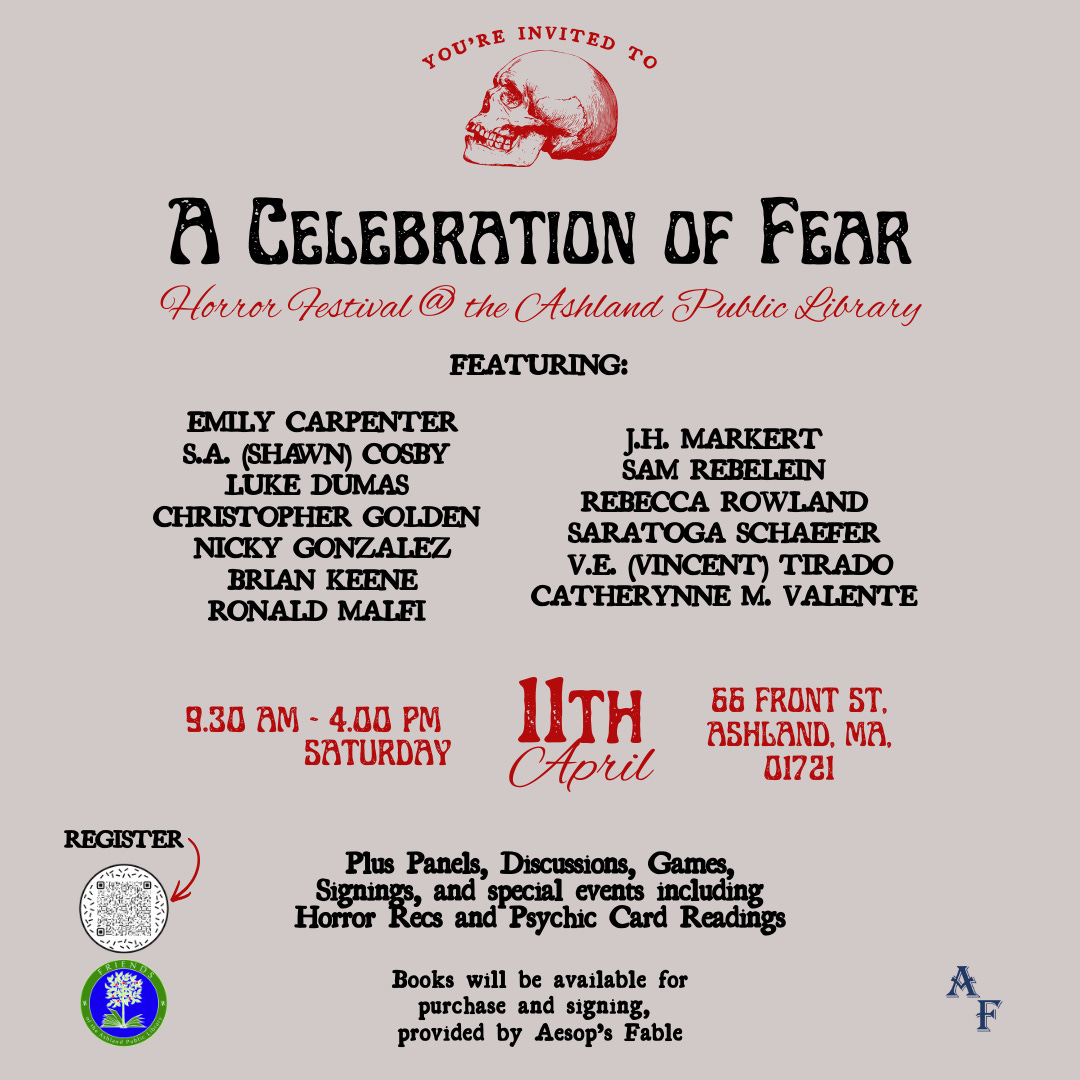
I’ll be a guest at A Celebration of Fear — a horror festival taking place April 11th at the Ashland Public Library 66 Front St, Ashland, MA 01721 from 9:30am to 4:00pm. There will be panels and signings. Also on hand will ne Christopher Golden, Ronald Malfi, Emily Carpenter, Rebecca Rowland, Catherynne Valente, S.A. Cosby, Luke Dumas, Nicky Gonzalez, J.H. Markert, Sam Rebelein, Saratoga Schaffer, and V.E. Tirado. Use the QR code below to register (or contact the library).
And for a complete list of where I’ll be appearing in 2026, click here.
We’re almost done principal photography on DEAD FORMAT — a new feature film written and directed by Mike Lombardo and produced by myself, Nathan Ludwig, and Samantha Kolesnik. We have another big shoot taking place at the end of this month, and then we’ll see where we are at, in regards to what’s left. After that, we’ll be deep into post production and editing. If you didn’t get a chance to back the film last year, you still can by going here. In the interest of full disclosure, that money will be used for housing and feeding cast and crew during the final shoots.
Role Playing - Keeneversations - Episode 31
Dungeons and Dragons. Gamma World. Car Wars. World of Darkness. Paranoia. Elfquest. Brian Keene and Mary SanGiovanni discuss their mutual love of these and other RPGs, and whether gaming helps or hinders their individual creativity. Subscribe for just $10 a month and listen now via Patreon or Spotify for $10. Previous episodes unlock after 6 months for nonsubscribers.
Currently Watching: Fallout season 2, Landman season 2, Kryptic, Mask, and Return To Silent Hill.
Currently Reading: Manuscripts by Todd Keisling and Bev Vincent.
Currently Listening: Crime of the Century and Even in The Quietest Moments both by Supertramp, Seven Year Itch by Collective Soul, and (on Sirius/XM) Howard 100, Howard 101, and Yacht Rock Radio.
Finished up Landman season 2 last night. I think this is probably my favorite of Taylor Sheridan’s stuff (enjoyed 1883, Mayor of Kingstown, and Tulsa King, could not get into Yellowstone and never made it past episode 2 despite trying twice, thought 1923 was just sort of “meh”, and haven’t yet gotten to 1923 season 2 or Lioness).
After hearing me complain for years that 1985’s Mask — one of my all-time favorite films, and notable for being some of the best roles ever for Cher, Eric Stoltz, and Sam Elliott — was unavailable for streaming on any platform, Wesley Southard recently gifted me with a copy of the movie on DVD. A surprising number of people have either never seen this film, or confuse it with Jim Carrey’s 1994 comic book adaptation The Mask. (Which brings to mind the same sort of confusion Christian fiction readers experienced back in the day when Lahaye and Jenkins released a new Left Behind book called The Rising, just a few short years after my own THE RISING, but I didn’t complain because those readers hoping for a continuation of the Left Behind saga got my zombie novel about Jim and Frankie and Ob and thus, caused a nice little sales bump all over again).
I don’t know if Mask has made it to streaming yet, but the DVD is very worth tracking down. I hadn’t seen the film in years, but after rewatching it, the movie remains one of my all-time favorites.
Dallas Mayr, aka Jack Ketchum, has been gone eight years this past week. Before we finish, I thought I’d share something I wrote about his most famous of novels. This piece was originally published in my book UNSAFE SPACES (which you can get here).
~
ONCE MORE, WITH FEELING: SOME THOUGHTS ON JACK KETCHUM’S THE GIRL NEXT DOOR
If you think of horror fiction in terms of water, we begin by throwing a rock into a small pool, creating ripples such as the Epic of Gilgamesh, Beowulf, and Lucian Samosata’s True History.
The ripples then become waves with Matthew Gregory’s The Monk (1796), Charles Maturin’s Melmoth the Wanderer (1820), and of course, the works of Mary Shelley, Bram Stoker, Edgar Allan Poe, Arthur Machen, and others. Those waves increase in size in the decades to follow, with work from such authors as H.P. Lovecraft, William Hope Hodgson, M.R. James, Lord Dunsany, Frank Belknap Long, Robert E. Howard, Clark Ashton Smith, Shirley Jackson, Fritz Leiber, Theodore Sturgeon, John Farris, Robert Bloch, Richard Matheson, Ray Bradbury, Rod Serling, Ramsey Campbell, Brian Lumley, and so many others.
In the Sixties, contemporary locales such as suburbia become horror fiction’s default setting, rather than crumbling waterfront towns and sprawling Victorian mansions. At this point, our waves transform into a tidal wave capable of sinking ships and swamping coastal towns.
Then, with the advent of Stephen King, that tidal wave becomes a fucking tsunami.
The impact Stephen King’s work had on the mainstream popularity of horror fiction cannot be understated. (And yes, right now, some of you are hollering, “I thought this was supposed to be about Jack Ketchum’s The Girl Next Door! What the hell, Keene?” Well, trust me. It is. Just be patient.)
Before Stephen King, horror fiction didn’t truly exist. Sometimes it was published as mainstream fiction, or occasionally mystery fiction. More often, it could be found safely ensconced with its siblings, science fiction and fantasy. The trio were considered a genre of one—most commonly referred to as speculative or “weird” fiction. When science-fiction became popular, booksellers and publishers created a marketing category to make it stand out on store shelves. When Stephen King became popular, the same was done for horror. A marketing category was created. Horror was stamped on the spines of books, and readers who were in-between the latest Stephen King or Dean Koontz novels could walk into a bookstore and find an entire genre of books that catered to them. The bookseller’s mantra became, “If you like Stephen King, you’ll like this.”
In terms of marketability and mainstream popularity, 1989 was perhaps horror fiction’s high water mark. Every mainstream publisher of note was racing to keep up with the consumers’ demands for “more books like Stephen King’s” which led to an increase in the number of mid-list paperbacks being published. Often, these paperbacks played to the lowest common denominator, plastering their covers with Day-Glo skeletons, demons, or other garish imagery (that often had nothing to do with the novel itself) with the stated goal of attracting the horror fan. (Two years later, the genre would see the birth of the legendary Dell/Abyss publishing line, which had, in part, hoped to offer a counterpoint to that).
But 1989 offered more than just an ease of availability for horror fiction fans. Not only had horror, as a genre category, been created, but there were sub-genres and factions that catered to a readers’ individual tastes. Fans who wanted more mainstream chills, typified by works like Stephen King’s (and birthed by previous masters such as Richard Matheson and Rod Serling) found it in the works of writers like F. Paul Wilson, James Herbert, or Robert R. McCammon. Those who preferred the quiet, often literary approach of Shirley Jackson or M.R. James had an abundance of such from authors like Peter Straub, Charles Grant, or T.E.D. Klein. For pulp fans of writers like Hugh B. Cave or Robert E. Howard, there was Richard Laymon and William W. Johnstone. And those who loved the more lurid, socio-political thrills offered by writers such as Robert Bloch or R. R. Ryan found an evolution among the splatterpunks, as typified by Clive Barker, David J. Schow, the duo of John Skipp and Craig Spector, or the selected early works of Joe R. Lansdale.
That’s where I come in.
In 1989, as a young man in my early-twenties, I was a voracious horror fiction reader, and I bought and devoured all of the above. My tastes were broad enough that I never allowed myself to become pigeonholed into liking one distinct sub-genre. Quiet or splatterpunk, literary or pulp, I read—and enjoyed—them all. But there was something missing. I didn’t know what that something was. I couldn’t articulate it. But I felt it just the same.
In the early Seventies, comic book scribe Steve Gerber made me want to be a writer. Later that decade, Stephen King made me want to be a horror writer. In the mid-Eighties, it was Richard Laymon’s first novel, The Cellar, that actually prodded me to believe that I, a lower-middle class kid with no hope of ever going to college, could actually become a horror novelist. And in 1989, it was Jack Ketchum’s The Girl Next Door that actually showed me how, while simultaneously showing me what had been missing all along.
In his seminal speech at the 1998 Bram Stoker Awards, author, editor, and scholar Douglas E. Winter stated, “Horror is not a genre. It is an emotion.”
Never has this been more apt than when it comes to discussing Jack Ketchum’s The Girl Next Door.
In 1989, a year when readers could choose between the traditional, literary, suggestively quiet horror typified by Grant, Klein, or Straub, and the artfully-gory, hyper-intensive limitless horror of the splatterpunks, Jack Ketchum’s The Girl Next Door arrived with (perhaps unknowingly) a middle finger firmly extended to both camps. It eschewed genre subcategories while simultaneously straddling them. The prose was lean when it needed to be (think Laymon by way of Charles Bukowski or Ernest Hemingway), and more expansive and literary when the narrative called for it. There were quiet, heartfelt, descriptive moments (especially at the beginning when protagonist David is introducing the reader to the town and the cast and what life is like for them) but these then give way to some of the most soul-rending physical and sexual atrocities ever committed to the printed page.
Because of the latter, some critics labeled The Girl Next Door as a new splatterpunk novel, but it wasn’t. While it certainly contained enough violence and blood to qualify as such, it differed on an emotional level from the standard splatterpunk fare. Until that point, even the most exceptional splatterpunk novel (and there were many) had been about art. Splatterpunk’s stated intention was that of the court jester, utilizing graphic, extremely gory prose to, as Phillip Nutman put it, “reflect the moral chaos of our times.” And while splatterpunk certainly succeeded with blood red colors at doing this, the artistic aspect was always prevalent, and thus, the reader’s emotional attachment to the work was often subdued. The best splatterpunk novels were like pretty paintings on the walls. You marveled at their beauty, but you couldn’t walk inside the painting and feel them. The same went for the other side of the genre. The quiet, traditional horror, while quite lovely to read, too often felt detached, and hard to connect with emotionally.
Emotion—primal emotion—was what had been missing from much of Eighties’ horror fiction, and The Girl Next Door brought it in spades. The novel went places that horror fiction simply wasn’t supposed to go to, but not just through the physical violence depicted therein. No. It evoked an emotional response in readers that horror fiction had long been lacking. If splatterpunk did indeed reflect humanity’s moral chaos, then The Girl Next Door was a mirror image of its pathos and sheer nihilism.
The Girl Next Door defied every subcategory that existed within the horror genre, and in doing so, set itself apart as something new. Something different. It wasn’t a novel painted in black and white, but in murky shades of gray. And red. There were no good guys. No last minute reprieves. No happy endings. The Girl Next Door didn’t just break down storytelling tropes and genre expectations—it gutted them in a basement bomb shelter and left them bleeding out on the floor. And in the process, it left many readers feeling the same way.
It left them feeling.
The Girl Next Door wasn’t Ketchum’s first novel. It was preceded by Off Season, Hide and Seek, Cover, and She Wakes. Nor was it his goriest novel (at that point, Off Season held that distinction — which is why, when discussing the origins of Extreme Horror, if you don’t start by mentioning Off Season then you’re doing it wrong). But the emotional gamut that Ketchum puts both the characters and the reader through in The Girl Next Door made it feel like one of the goriest, most extreme works within the genre to that date.
And that feeling still resonates today.
It resonates every time you read something written by much of my generation of writers. Indeed, there are quite literally multiple dozens among today’s current generation of prominent horror authors who include The Girl Next Door as a major influence on their work. (The only other novels that have had as much influence are Stephen King’s IT and Joe R. Lansdale’s The Drive-In). They hail from all of the genre’s different and divergent subcategories. And they all agree that The Girl Next Door defied those categories, and created something new—a blueprint, from which a new generation of authors often operated.
When I first purchased The Girl Next Door, I had no idea of the emotionally-harrowing ride I was about to take. I bought it simply because I’d enjoyed Off Season in High School, and it was written by the same guy, and there was a skeleton cheerleader on the cover. Yes, that old Warner Books cover is unfortunate, but it served its purpose at the time—letting young people like myself know that here was a book we might like to read.
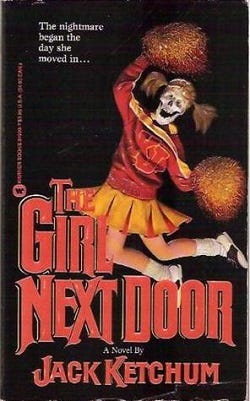
And read it I did.
The book left me broken, upon finishing. But it also had me breaking down my own then-meagre attempts at writing, and starting over again, once more with feeling. That had been the missing ingredient. Feeling. And I don’t think it’s hyperbole to say that, were it not for that novel, I might not be doing this for a living today. And some of the writers I mentioned above, ones who were also inspired by it, have said the same thing about its impact on them.
To learn, years later, that the inspirational basis for the novel stemmed from true events (the Sylvia Likens murder), only enforces the theory that it was a mirror image of humanity’s pathos and nihilism. Re-reading the novel after discovering its origin only increases the emotional impact. And re-reading it a third time, years later, as a parent… let’s just say I was broken all over again.
Years ago, Jack Ketchum sat in a bar and negotiated my very first novel contract for me (for a book called The Rising, which Delirium Books and Dorchester Publishing had both made offers on, for hardcover and paperback, respectively). When he’d finished red-penning the Dorchester contract, Ketchum told me to keep it and use it as a template for every novel contract I’d negotiate in the future. I have done just that, and I will always be grateful to him for that kindness, and the friendship we’ve developed in years since. But I’m even more grateful to him for writing The Girl Next Door. I know what it’s like to read it, but can you imagine what it was like to actually write it? The emotional toll must have been devastating at times—but worth it, in the end.
Our genre would be very different without it. And so would the emotional impact that our genre, when at its best, has provided since then.
And that does it for this week. Thanks for reading. I’ll see you every day this week on my Blog and back here next Sunday.
Movie marketing in general has been in the toilet. I’m still shocked that last year, there was a new Spike Lee movie with Denzel Washington as the lead and I didn’t hear a peep about it until two weeks (!!) before release, and that was in a newsletter from the AFI Silver Theater. I did see ads for Primate and The Bone Temple but it was in front of other movies, not much elsewhere. It’s like Hollywood decided we need ten new movies a week but only heavily market four per year.
THE GIRL NEXT DOOR broke me too when I read it. I met Dallas shortly afterward at my first Necon in 2000 and told him the book messed me up. He replied that he was glad it messed me up, because he wouldn't want to meet the kind of person it didn't.